


Thresholds in Architecture: Defining Transitions Between Space, Experience, and Meaning

Updated: Apr 30
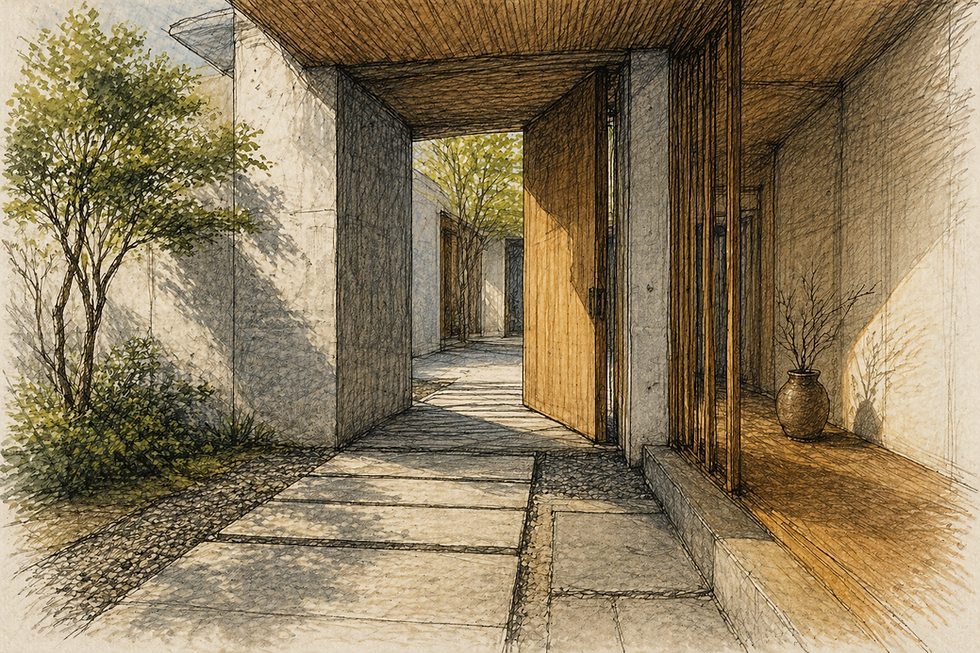
In architecture, spaces are rarely isolated. They are connected through moments of transition that shape how we move, perceive, and understand the built environment. These moments are known as thresholds. While often associated with doors or entrances, thresholds extend far beyond physical openings. They are spatial, sensory, and conceptual conditions that define the shift from one state to another.
A threshold is not simply a boundary. It is an experience.
Beyond the Door: Expanding the Definition
Traditionally, a threshold refers to the point of entry between outside and inside. However, in architectural thinking, the concept is much broader. Thresholds can occur between public and private space, light and shadow, open and enclosed environments, or even between different emotional atmospheres.
A narrow corridor leading into a large hall, a shaded porch before entering a home, or a gradual change in material underfoot can all act as thresholds. These transitions prepare the user for what comes next. They frame experience and create anticipation.
In this sense, thresholds are not just points. They are sequences.
Spatial Gradation and Transition
One of the key roles of thresholds is to soften transitions between contrasting spaces. Instead of moving abruptly from one condition to another, architecture can introduce layers that create a sense of progression.
For example, moving from a street into a building might involve a series of steps: sidewalk → entry platform → vestibule → interior space. Each stage adjusts scale, light, sound, and enclosure. This layered approach helps users orient themselves and understand their position within the building.
Without such transitions, spaces can feel disconnected or abrupt. Thresholds provide continuity.
Thresholds and the Human Body
Thresholds are deeply connected to the human body and perception. They are experienced physically through movement and scale. A low doorway may require a slight bow. A compressed passage may slow movement. A widened opening may invite gathering.
These bodily interactions are not accidental. They are design decisions that influence how people behave in space. Thresholds can guide, pause, or redirect movement. They can create moments of awareness where users become more conscious of their surroundings.
In this way, thresholds shape not only space, but also behavior.
Light, Material, and Atmosphere
Thresholds are often defined through changes in light and material. A transition from bright exterior sunlight to a dim interior creates a strong sensory shift. Similarly, moving from rough stone to smooth wood, or from hard pavement to soft ground, signals a change in condition.
Light can be filtered, diffused, or framed to emphasize transition. Materials can shift in texture, color, or temperature. These changes communicate information without words, allowing users to intuitively understand movement through space.
Atmosphere is therefore a critical component of thresholds. It is not only about where you are going, but how you arrive.
Cultural and Symbolic Meaning
Thresholds also carry cultural and symbolic significance. In many traditions, the act of crossing a threshold represents a change in status or condition. Entering a home, a place of worship, or a civic building often involves a moment of transition that reflects respect, privacy, or ceremony.
Architecture can reinforce these meanings through scale, ornament, or spatial sequence. A grand entrance may emphasize importance, while a subtle threshold may suggest intimacy or informality.
These symbolic dimensions remind us that thresholds are not only physical, but also social and cultural constructs.
Thresholds in Contemporary Architecture
In contemporary practice, thresholds continue to play a central role, though often in more abstract ways. Open plans, glass facades, and fluid spaces challenge traditional boundaries, yet thresholds still exist through gradients rather than clear divisions.
Architects today often explore blurred thresholds—spaces that are neither fully inside nor outside, neither public nor private. Courtyards, terraces, covered walkways, and transitional landscapes become key elements in defining these conditions.
This approach reflects a broader shift toward flexibility and continuity in design.
The Importance of Sequence
Ultimately, thresholds are about sequence. Architecture is not experienced as a single moment, but as a series of transitions over time. The quality of these transitions determines how a building is understood and remembered.
Well-designed thresholds create rhythm. They establish a narrative that guides the user through space. They can create tension, release, anticipation, or calm.
Without attention to thresholds, architecture risks becoming static. With them, it becomes dynamic and experiential.
Conclusion
Thresholds are among the most subtle yet powerful tools in architecture. They define how spaces connect, how users move, and how experiences unfold. More than physical boundaries, they are moments of transformation that shape perception and meaning.
By carefully designing thresholds—through space, light, material, and sequence—architects can create environments that are not only functional, but also deeply engaging and memorable.
In this way, architecture becomes not just a collection of rooms, but a journey.


Comments