


Defamiliarization in Architecture: Seeing the Familiar in Unfamiliar Ways

Updated: Apr 30
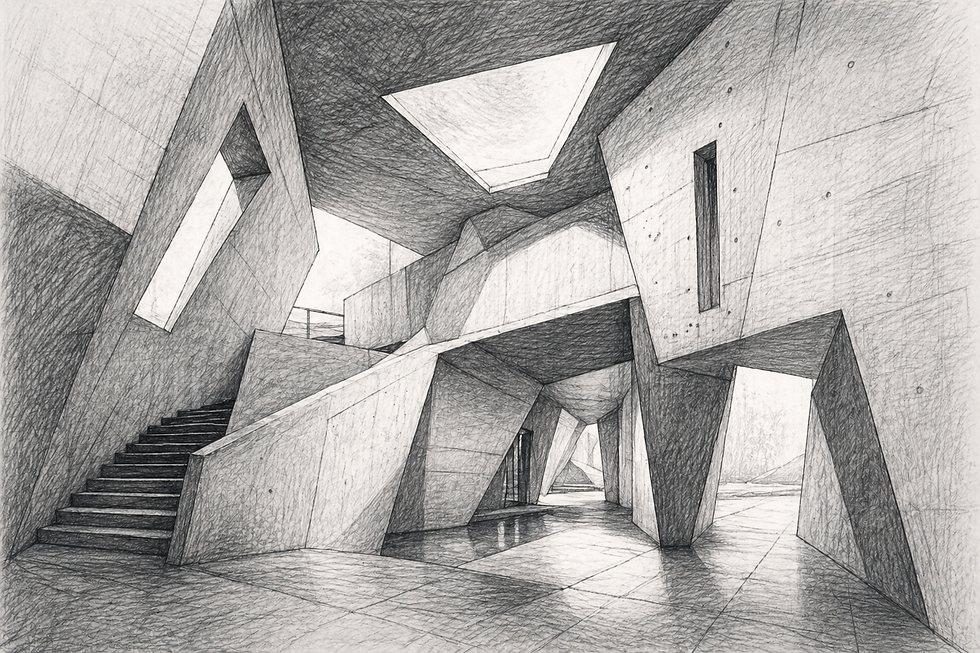
Architecture is often expected to provide clarity, function, and comfort. Buildings guide movement, organize space, and support daily life in ways that feel natural and intuitive. Yet some of the most powerful architectural experiences emerge when this sense of familiarity is intentionally disrupted. This is where the concept of defamiliarization becomes important.
Originally developed in literary theory, particularly by the Russian formalist Viktor Shklovsky, defamiliarization refers to the act of making the familiar seem strange in order to renew perception. Applied to architecture, it describes design strategies that challenge habitual ways of seeing, moving, and understanding space. Rather than simply accommodating expectations, architecture can provoke awareness by altering them.
From Literature to Space
In literature, defamiliarization slows down perception. It forces the reader to pay attention to details that would otherwise be overlooked. In architecture, a similar effect occurs when space resists immediate understanding. A corridor that bends unexpectedly, a wall that shifts scale, or a material used in an unfamiliar way can interrupt routine perception.
This interruption is not confusion for its own sake. It is a deliberate strategy to heighten awareness. By breaking the automatic relationship between user and space, architecture becomes more than background. It becomes an active experience.
Disrupting Expectations
Defamiliarization in architecture often begins with the disruption of expectations. People carry mental models of how buildings should work: doors lead to rooms, stairs connect levels, windows frame views. When these expectations are challenged, attention increases.
This can happen through spatial sequence, proportion, or orientation. A space might compress before expanding, tilt slightly, or reveal itself gradually rather than immediately. These moments encourage users to pause and re-evaluate their surroundings.
In this sense, defamiliarization is not about making architecture difficult, but about making it perceptible.
Material and Sensory Experience
Materials play a key role in defamiliarization. When familiar materials are used in unfamiliar ways, they can transform how a space is understood. Concrete may appear soft through light and texture, glass may feel solid through layering, or wood may be used in unexpected structural expressions.
Light is equally important. Shadows, reflections, and controlled illumination can distort depth and scale, creating ambiguity. Sound, temperature, and even smell can contribute to this sensory shift.
Through these strategies, architecture engages more than vision. It becomes a multi-sensory experience that challenges habitual perception.
Scale and the Body
Defamiliarization often operates through scale. Architecture typically aligns with human proportions to provide comfort and usability. When scale is altered—slightly or dramatically—it can create a sense of tension or curiosity.
A doorway that feels too tall, a ceiling that lowers unexpectedly, or a space that exaggerates distance can all shift the relationship between the body and the environment. These changes make users more aware of their own presence within space.
The body becomes a measuring tool, and architecture becomes something to be felt rather than simply used.
Movement and Sequence
Architecture is experienced over time, and defamiliarization often emerges through movement. Rather than presenting a space all at once, architects can choreograph sequences that unfold gradually.
This approach is closely associated with architects such as Bernard Tschumi and Daniel Libeskind, whose work explores fragmentation, narrative, and spatial tension. In their projects, movement is not always direct or predictable. Instead, it becomes part of the architectural concept.
As users move through such spaces, they are constantly reorienting themselves. This process creates a deeper engagement with the environment.
Defamiliarization and Meaning
One of the most important aspects of defamiliarization is its ability to generate meaning. By disrupting expectations, architecture can draw attention to social, cultural, or historical conditions.
For example, a building may intentionally create discomfort to reflect memory or loss. It may fragment space to represent complexity or conflict. In such cases, defamiliarization is not only perceptual, but also conceptual.
Architecture becomes a medium for reflection rather than just occupation.
Risks and Limitations
While defamiliarization can be powerful, it must be used carefully. If taken too far, it can result in spaces that are confusing, inaccessible, or alienating. Architecture must still function, and users must still be able to navigate and inhabit it effectively.
The challenge is balance. Successful defamiliarization creates moments of awareness without compromising usability. It invites curiosity without creating frustration.
This balance requires a clear understanding of both design intent and user experience.
Contemporary Relevance
In contemporary practice, defamiliarization continues to influence experimental and conceptual architecture. It is often used in museums, cultural institutions, and installations where experience and interpretation are central.
At the same time, its principles can be applied subtly in everyday architecture. Even small shifts in material, light, or sequence can transform how a space is perceived.
In a world where many environments are standardized and repetitive, defamiliarization offers a way to re-engage users with the built environment.
Conclusion
Defamiliarization in architecture is not about novelty alone. It is about perception. By making the familiar unfamiliar, architecture can reveal qualities of space that are often overlooked. It can slow down experience, deepen awareness, and create meaningful engagement.
In this sense, defamiliarization reminds us that architecture is not only about solving problems, but also about shaping how we see, feel, and understand the world around us.


Comments